
Every year, farmers, vegetable storage facilities, and wholesale businesses lose 20-40% of their harvest to incorrect storage conditions. A temperature just 2-3 degrees above the recommended range, insufficient humidity, or uneven airflow can turn produce that should last eight months into spoiled stock within six weeks.
The right vegetable storage equipment solves this problem at every level: it maintains precise temperature and humidity settings, ensures even air circulation, and lets you store your harvest with minimal losses throughout the off-season.
This guide walks through how to choose refrigeration equipment for a vegetable storage facility, the correct storage conditions for different crops, and why a «one-size-fits-all» system is the wrong choice when your business depends on getting these parameters exactly right.
Who Needs Industrial Cold Storage Rooms for Vegetables
Cold storage rooms for vegetables aren’t reserved for large agricultural holdings. Industrial vegetable storage equipment makes sense for:
- Farms and agricultural producers — to control when their harvest reaches the market instead of selling everything at rock-bottom prices during peak season;
- Wholesale distributors and logistics companies — to receive large shipments from suppliers and release them gradually over an extended period;
- Food processing facilities — to keep production lines running continuously, regardless of seasonal fluctuations in raw material supply;
- Retail chains and distributors — to store a wide range of produce with different temperature requirements side by side.
The rule of thumb is simple: if the value of the produce being stored runs into tens of thousands of euros, the right vegetable cold storage room pays for itself within one or two seasons through reduced losses alone.
Vegetable Storage Temperature Settings: What to Know Before Choosing Equipment
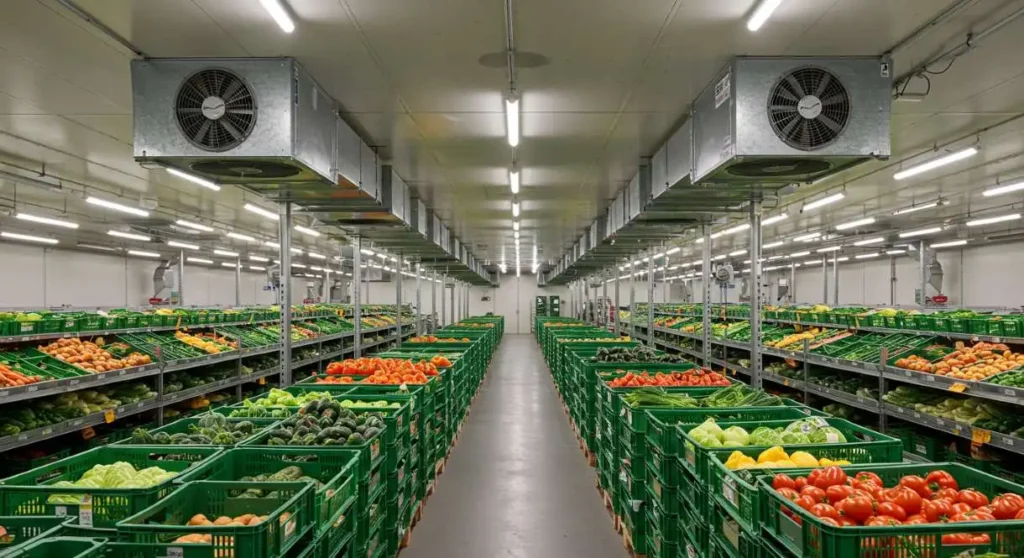
The most common mistake when setting up a vegetable storage facility is buying equipment meant to handle «everything at once» without accounting for the actual needs of specific crops. Different vegetables have fundamentally different temperature and humidity requirements, and deviating from the norm in either direction leads to losses.
Vegetable Storage Conditions at a Glance
| Crop | Temperature, °C | Relative Humidity, % | Shelf Life |
|---|---|---|---|
| Potatoes | +4.5 … +10 | 85–90 | up to 8 months |
| Carrots | −1 … +1 | 92–95 | up to 8 months |
| Beets | 0 | 90–95 | up to 6 months |
| Cabbage | −1 … +1 | 85–95 | up to 8 months |
| Onions | −1 … +1 | 70–75 | up to 8 months |
| Garlic | −1 … +1 | 70–75 | up to 6 months |
| Tomatoes | +7 … +10 | 85–90 | up to 4 weeks |
| Fresh peppers | +7 | 90 | up to 3 weeks |
| Cucumbers | 0 | 85–90 | up to 2 weeks |
| Eggplant | +7 | 90 | up to 3 weeks |
| Mushrooms | 0 … +1 | 85–90 | up to 10 days |
| Spinach & leafy greens | −0.5 … +1 | 90–95 | up to 2 weeks |
Note one critical detail: onions need much lower humidity (70-75%) than carrots (92-95%). Storing these crops in the same room without separate zones will reliably ruin part of one or the other. For businesses handling a mixed range of produce, Koriel Group designs sectioned cold rooms or several independent storage modules.
What Sets Quality Vegetable Storage Equipment Apart From the Mid-Market Crowd
The market offers dozens of refrigeration options — from low-cost units to overpriced premium brands. When choosing equipment for industrial-scale vegetable cold storage, a handful of parameters actually matter.
Temperature Accuracy
Consumer-grade and semi-industrial systems typically deviate ±2-3°C from the target setpoint. For potatoes stored at +6°C, a swing up to +9°C speeds up metabolic activity and triggers premature sprouting. Koriel Group’s industrial systems hold temperature within ±0.5°C — a difference that matters enormously for long-term storage.
Even Airflow Distribution
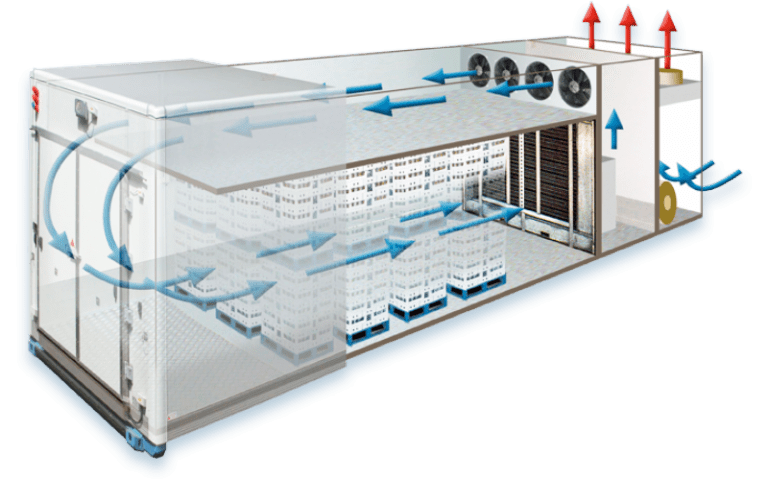
Uneven cold air distribution is the leading cause of frost damage zones and warm spots within the same cold room. A properly engineered ventilation system and correctly positioned evaporators ensure consistent airflow throughout the entire volume, regardless of how full the room is.
Humidity Control
Most low-cost systems cool the air while drying it out at the same time. The result: the top layers of produce shrivel, losing both weight and market value. Quality vegetable storage ventilation equipment includes humidifiers or evaporator settings tuned to minimize moisture loss from the air.
Energy Efficiency
A vegetable cold storage room runs almost continuously for 6-9 months at a time. The difference in power consumption between an efficient system and an outdated unit can reach 30-45%. At European electricity rates, that adds up to thousands of euros a month — costs that go straight into your cost of goods.
Remote Monitoring and Control
Modern industrial cold rooms come with monitoring systems that can be controlled from a smartphone. This matters most for producers who aren’t always on-site: any deviation in parameters is flagged immediately, and an alert is sent straight to your phone.
Key Parameters for Sizing a Vegetable Storage Refrigeration System
Properly sizing equipment for industrial vegetable storage starts with calculating the total heat load. This includes several components.
Heat Gain Through the Building Envelope
This depends on the insulation material and thickness used in the walls, ceiling, and floor, the temperature difference between outside and inside the room, and regional climate conditions. With summer temperatures of +35-38°C and an internal room temperature of +2°C, that’s a 33-36 degree difference — a substantial load that demands the right refrigeration capacity to match.
Heat Gain From Incoming Produce
Freshly harvested vegetables arrive at ambient temperature and release a significant amount of heat as they cool down to the target setpoint. For a 50-tonne batch of potatoes that needs to go from +20°C down to +6°C, the system has to remove that heat load within the calculated timeframe — without overloading the compressor in the process.
Respiration Heat From the Produce
Vegetables are living organisms that continue to respire even at low temperatures. The rate of respiration dependson the crop and the temperature, and it’s a constant source of heat throughout the entire storage period. This factor is always factored into the required refrigeration capacity calculation.
Stacking Density and Optimal Room Loading
Stacking produce too tightly blocks airflow and causes uneven cooling. Stacking too loosely wastes floor space and drives up the cost per unit of stored product. Below are reference stacking densities for the main crops.
| Crop | Stacking Density, kg/m³ |
|---|---|
| Potatoes | 700 |
| Onions | 450 |
| Cabbage | 610 |
| Carrots | 420 |
| Fresh peppers | 400 |
| Cucumbers | 500 |
| Spinach | 610 |
Common Mistakes When Setting Up a Vegetable Storage Facility
In practice, most vegetable storage problems don’t come from faulty equipment — they come from systemic mistakes made at the design or equipment-selection stage.
Sizing equipment with no safety margin. Equipment sized to match the calculated load exactly, with no buffer, falls short during peak demand — for instance, when large batches arrive during hot weather. Koriel Group always builds in a capacity margin that accounts for real-world operating conditions.
Ignoring temperature variation across the facility. Areas near doorways always run warmer due to warm-air infiltration. Without accounting for this at the design stage, produce stored in these «warm zones» spoils even when the system overall is working correctly.
Cutting corners on insulation. Investing in quality insulation with panel thickness of 100mm or more pays for itself in reduced energy costs within 1-2 seasons. «Budget» insulation means paying that energy premium for the entire lifespan of the facility.
No monitoring system in place. A failed sensor or a power outage overnight can wipe out an entire batch of stored produce — if there’s no alert system in place to flag the problem in time.
Storing incompatible crops together. Even a small amount of fruit stored near vegetables releases enough ethylene gas to speed up ripening and spoilage across a significant portion of the stored produce.
Vegetable Cold Storage Rooms From Koriel Group: Why Businesses Choose Us
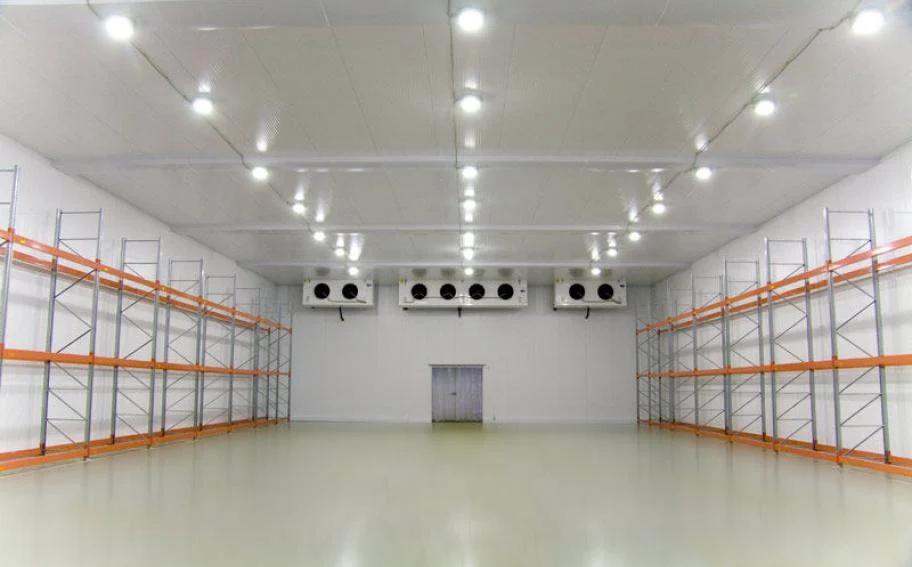
Koriel Group specializes in manufacturing and supplying industrial refrigeration systems for the agricultural, food processing, and logistics sectors. Our vegetable storage equipment stands apart on several key points.
100% European components. Every Koriel Group unit is built exclusively from components made by leading European manufacturers — Copeland, Danfoss, Güntner, and Bitzer. That’s the foundation of reliable, long-lasting equipment.
Factory testing before shipment. Every system goes through a full testing cycle at Koriel Group’s facility before it reaches you. You receive equipment that has already proven it meets spec.
Up to 45% lower energy use. The energy-efficient design Koriel Group builds into every system significantly cuts electricity costs compared to outdated or poorly matched equipment.
Wide operating range. Koriel Group units operate reliably in ambient temperatures from −30°C to +45°C. Across European climates — hot summers and cold winters alike — that means stable, year-round performance with no limitations.
Warranty up to 5 years. The standard warranty is 1 year, extendable up to 5 years — one of the best warranty terms available in the industrial refrigeration market.
Smartphone monitoring. Every Koriel Group system can connect to a monitoring platform — giving you real-time parameter tracking, an event log, and remote control from any device, anywhere in the world.
Custom engineering for every project. Koriel Group doesn’t sell off-the-shelf «boxed» solutions. Every project is engineered around the specific facility, the produce being stored, and the actual operating conditions. You pay only for the functionality you actually need — nothing more.
How Ordering a Vegetable Cold Storage Room From Koriel Group Works
From the first inquiry to the system going live, the process follows a few clear stages:
-
Fill out a project questionnaire — our engineering team gathers the basics: room dimensions, the
crops to be stored and their volumes, the desired storage period, and the local climate zone; -
Technical calculation — we determine the required refrigeration capacity, select the equipment,
and put together a specification with exact unit models and components; - Commercial proposal — a fixed price for equipment and installation, with no hidden fees;
- Manufacturing and testing — production, assembly, and factory testing of the system;
-
Installation and commissioning — our team travels to your site, installs the equipment, charges
the refrigerant, configures the automation, and verifies all operating parameters; -
Staff training and documentation handover — so your team can independently handle routine
maintenance going forward.
The company also provides service and maintenance for refrigeration systems — scheduled preventive maintenance, emergency call-outs, and original spare parts.
Conclusion
A properly chosen vegetable cold storage room isn’t a cost — it’s an investment that pays for itself through reduced losses in the very first season. The keys to success: precise temperature control tailored to each crop, humidity management, even airflow, and a reliable monitoring system.
Buying generic, «average» equipment without a custom engineering calculation is the most expensive mistake you can make when setting up a vegetable storage facility. The outcome is almost always the same: the system can’t keep up during peak loads, consumes far more electricity than necessary, or simply can’t hold the precision required for long-term storage.
Koriel Group designs, manufactures, and installs refrigeration systems for vegetable storage facilities across Europe — built around your specific facility, your produce, and your budget.
Want us to calculate the optimal solution for your vegetable storage facility? Call or write to us today.