
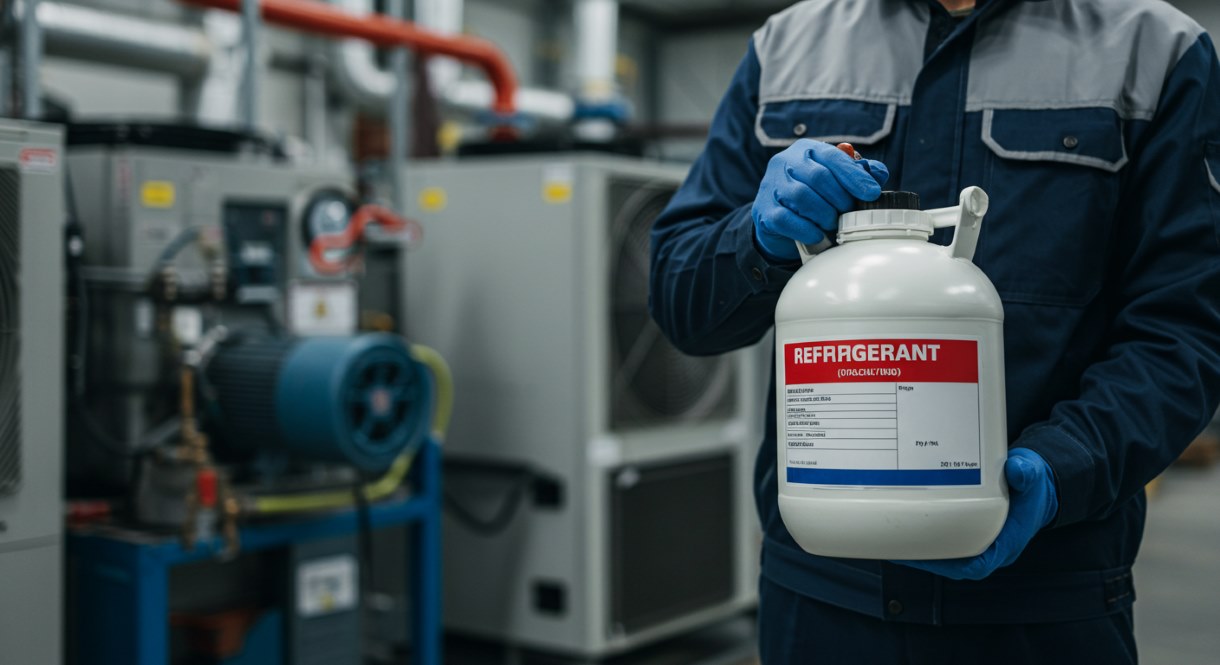
R744 — the ASHRAE designation for carbon dioxide (CO₂) used as a refrigerant — has become one of the leading standards in industrial refrigeration across Europe over the past decade. Rising energy costs, tightening EU environmental regulations, and the accelerating phase-down of high-GWP HFC refrigerants are pushing industrial operators to find long-term alternatives. CO2 refrigeration systems represent today’s most compelling answer to those challenges.
In this guide, the engineering team at Koriel Group covers everything you need to know about R744: its technical properties, real-world performance advantages and limitations, a side-by-side comparison with R404A and R717, and the facilities where a CO2 refrigeration system delivers the strongest return on investment.
What Is R744 Refrigerant?
R744 is the ASHRAE classification for carbon dioxide (CO₂) when used as a refrigerant. It is a naturally occurring substance that requires no chemical synthesis, carries zero ozone depletion potential, and has a global warming potential of just 1 — the lowest possible value for any refrigerant in commercial use today.
Key physical and environmental properties of R744:
- Chemical formula: CO₂
- ASHRAE designation: R744
- Ozone Depletion Potential (ODP): 0
- Global Warming Potential (GWP): 1
- Critical temperature: 31.1°C (88.0°F)
- Critical pressure: 73.8 bar (1,070 psi)
- Discharge pressure — subcritical mode: 40–60 bar
- Discharge pressure — transcritical mode: up to 90–120 bar
- Flammability: none (ASHRAE safety class A1)
- Toxicity: non-toxic at normal operating concentrations
- Operational temperature range: −55°C to +10°C (−67°F to +50°F)
The volumetric refrigerating capacity of CO₂ is 3–8 times higher than most HFC refrigerants. This allows engineers to design more compact systems with smaller-diameter pipework and a significantly reduced refrigerant charge — an important advantage both for new builds and retrofits with limited plant room space.
Why Are Industrial Operators Switching to R744?
The primary driver is regulatory. The EU F-Gas Regulation mandates a phased reduction in the quotas for high-GWP hydrofluorocarbon refrigerants. R404A (GWP 3,922) and R507A (GWP 3,985) are already heavily restricted for new installations, and servicing costs for existing systems are climbing sharply as refrigerant supply tightens.
With GWP=1, R744 sits entirely outside the scope of any current or anticipated restriction. An industrial operator who invests in a CO2 refrigeration system today is acquiring equipment with zero regulatory obsolescence risk for the next 20+ years — a factor that substantially changes the lifecycle cost calculation.
Advantages of R744 as an Industrial Refrigerant

1. Minimal Environmental Impact
GWP=1 and ODP=0 represent the absolute minimum among commercially available refrigerants. For comparison: R404A carries a GWP of 3,922; R410A, 2,088; R134a, 1,430. A refrigerant leak from a CO2 system has no meaningful climate impact — a critical consideration for ESG reporting and supply chain compliance.
2. High Energy Efficiency with Heat Recovery
A well-engineered CO2 system with integrated heat recovery can be 10–30% more energy-efficient than a comparable R404A installation. The key advantage lies in the gas cooler: CO₂ rejects heat at 60–90°C — far higher than most HFC systems (40–55°C) — making it practical to redirect that thermal energy to hot water supply or space heating. For facilities running 24/7, this translates into a measurable reduction in total energy costs.
3. Full F-Gas Compliance — Now and in the Future
R744 is not subject to any current or planned restrictions under the EU F-Gas Regulation. It is the only refrigerant for which no phase-down scenario exists in the foreseeable future, removing a major source of long-term financial risk for plant operators.
4. Compact System Design
The high volumetric refrigerating capacity of CO₂ enables smaller-bore pipework and more compact compressor units. This is a particularly valuable characteristic when upgrading existing facilities where machine room space is constrained, or when minimising refrigerant inventory on multi-temperature sites.
5. Safety Profile
R744 is classified A1 under ASHRAE Standard 34 — non-flammable and non-toxic at working concentrations. Unlike ammonia (R717), which requires strict safety engineering, exclusion zones, and specialist operator training, CO2 refrigeration systems can be installed directly in production and warehouse areas without additional protective structures or restricted zones.
Limitations and Technical Considerations for R744
Despite its advantages, CO2 refrigeration systems have engineering characteristics that directly affect project cost and complexity. Understanding these is essential for accurate feasibility assessment.
- High operating pressure. Up to 120 bar in transcritical mode — four to twelve times higher than HFC systems (10–25 bar). All pipework, fittings, valves, and heat exchangers must be pressure-rated accordingly, increasing component costs compared to conventional systems.
- Transcritical operation in warm climates. When ambient air temperature exceeds 31°C, the system enters transcritical mode. Without proper design — gas cooler sizing, ejector integration, flash gas bypass — efficiency can deteriorate significantly during summer peak loads.
- Higher demand on installation quality. Joint integrity and pipework quality are critical at these pressures. This places greater responsibility on the contracting company’s qualifications and QA procedures during installation.
- More complex commissioning and controls. CO2 systems require precise control algorithms — particularly in transcritical mode where operating conditions vary with ambient temperature. Initial commissioning and set-up take longer than for conventional HFC plant.
For these reasons, industrial CO2 refrigeration projects should only be entrusted to contractors with a verified track record in R744 systems. Design errors carry a disproportionately higher cost than in traditional HFC installations.
R744 vs R404A vs R717: Side-by-Side Comparison for Industrial Facilities
| Parameter | R744 (CO₂) | R404A | R717 (Ammonia) |
|---|---|---|---|
| GWP | 1 | 3,922 | 0 |
| ODP | 0 | 0 | 0 |
| Working pressure | up to 120 bar | 10–25 bar | up to 20 bar |
| Toxicity | No | No | Yes (class B2L) |
| Flammability | No | No | Mildly flammable |
| Heat recovery temperature | 60–90°C | 45–55°C | 60–90°C |
| F-Gas restrictions | None | Yes (phase-down) | None |
| Installation cost | Higher | Medium | Higher |
| Permissible installation zones | Unrestricted | Unrestricted | Restricted (toxic) |
Transcritical CO2 Systems: How They Work and When They Apply
A transcritical CO2 system is one in which the refrigerant during the heat rejection phase is above its critical point (31.1°C / 73.8 bar). At these conditions, condensation does not occur — instead, heat is removed from the CO₂ gas in a gas cooler before it expands.
Transcritical operation is the norm for climates where summer ambient temperatures regularly exceed 25–30°C — which includes most of Ukraine, Poland, and Central and Southern Europe. This is not a design limitation but an operating mode that must be accounted for in system design from the outset.
To maintain efficiency in transcritical mode, the following technologies are applied in modern CO2 refrigeration systems:
- ejectors for pressure energy recovery;
- parallel compression to handle flash gas;
- adiabatic pre-cooling of the gas cooler;
- integrated heat recovery loops for hot water supply and space heating.
Modern transcritical CO2 systems fitted with ejectors and parallel compression now achieve COPs that exceed conventional HFC systems even at ambient temperatures of +35°C and above — a performance threshold that was considered challenging only a few years ago.
Industrial Applications of R744
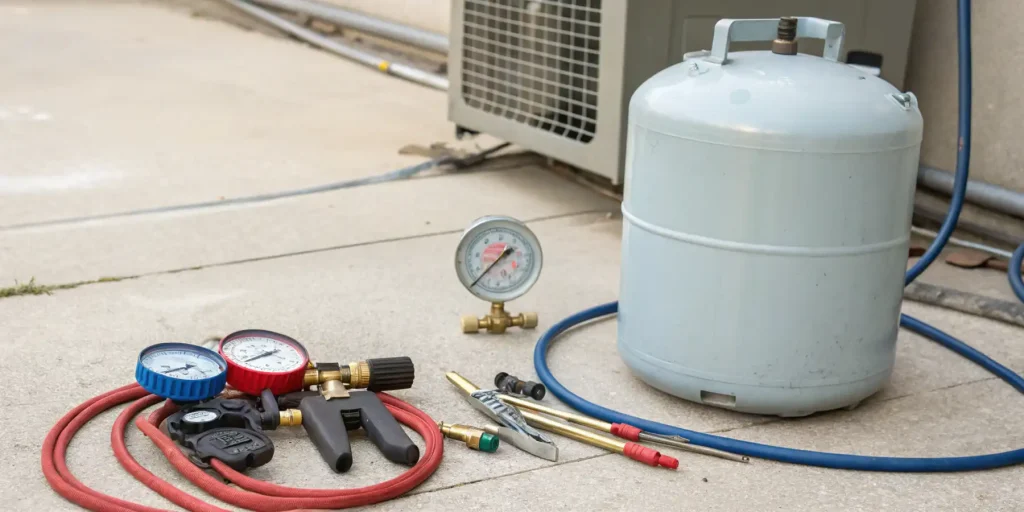
Today, CO2 refrigeration systems are being actively deployed across a wide range of industrial and commercial facilities:
- cold storage warehouses and refrigerated logistics centres;
- blast freezing tunnels and IQF systems for meat, fish, berries, and vegetables;
- meat processing plants and slaughterhouses;
- dairy production and cheese maturation facilities;
- food manufacturing and confectionery plants;
- pharmaceutical cold chain storage;
- supermarket refrigeration and retail distribution centres;
- ice rinks and sports arena cooling infrastructure.
For facilities requiring simultaneous low-temperature freezing (−35°C to −45°C) and medium-temperature storage (+2°C to +4°C), CO2 enables the use of booster refrigeration systems — a single-refrigerant circuit serving two temperature levels, which reduces total equipment cost and simplifies ongoing maintenance compared to two separate systems.
Heat Recovery in CO2 Refrigeration Systems
One of the strongest practical arguments for R744 in industrial applications is its exceptional heat recovery potential. The gas cooler of a CO2 system rejects heat at 60–90°C — substantially higher than most HFC systems (40–55°C) — making that thermal energy directly usable in production processes.
Recovered heat from a CO2 refrigeration system can be applied to:
- process hot water heating to 65–85°C;
- space heating for production halls, warehouses, and offices;
- air heating in HVAC and ventilation systems;
- any production process requiring a reliable hot water source.
For round-the-clock operations — cold stores, food processing lines, logistics hubs — heat recovery from a CO2 system can offset 40–60% of total thermal energy demand, delivering a material reduction in gas or electric heating costs that strengthens the investment case considerably.
Automation and Monitoring for CO2 Refrigeration Systems
CO2 refrigeration systems place higher demands on control system quality than conventional HFC plant. Because operating conditions shift substantially between subcritical and transcritical modes — particularly across seasons — the control algorithms must actively manage:
- real-time ambient air temperature and its effect on high-side pressure;
- discharge and suction pressure management;
- gas cooler performance and heat rejection efficiency;
- heat recovery loop operation and priority logic;
- load balancing across multiple compressors.
Leading control platforms — Danfoss AK-System Manager, Carel pRack, and similar — provide comprehensive monitoring and remote management of industrial CO2 refrigeration systems in real time, including dashboards, automated reports, and configurable alarms for deviations from set parameters.
R744 and the Future of Industrial Refrigeration
According to the European Partnership for Energy and the Environment (EPEE) and the Environmental Investigation Agency (EIA), the share of new industrial refrigeration installations using natural refrigerants is growing year on year across Europe. CO2 holds the top position among natural refrigerants by rate of adoption in the industrial segment.
For operators planning new cold storage facilities or modernising existing plant, choosing R744 today means:
- full compliance with current and forthcoming EU environmental regulations;
- protection against rising HFC refrigerant procurement costs;
- eligibility for state subsidies and green investment grants for energy-efficient equipment in several European
markets; - a competitive advantage with partners and customers who have active ESG procurement requirements.
Summary
R744 (CO₂) is a natural refrigerant with GWP=1 that combines environmental responsibility, technical performance, and long-term regulatory stability. A properly engineered CO2 refrigeration system delivers:
- full compliance with the EU F-Gas Regulation and all future environmental requirements;
- reduced energy costs through integrated heat recovery;
- reliable operation across a temperature range of −55°C to +10°C;
- a system service life of 20+ years with zero risk of refrigerant regulatory restriction.
Koriel Group designs, installs, and services industrial CO2 refrigeration systems for food processing enterprises, cold storage facilities, and logistics centres across Ukraine and Europe.
Planning a transition to CO2 refrigeration or building a new cold storage facility? Submit an enquiry — our engineers will provide a free technical consultation and a preliminary system calculation for your site.