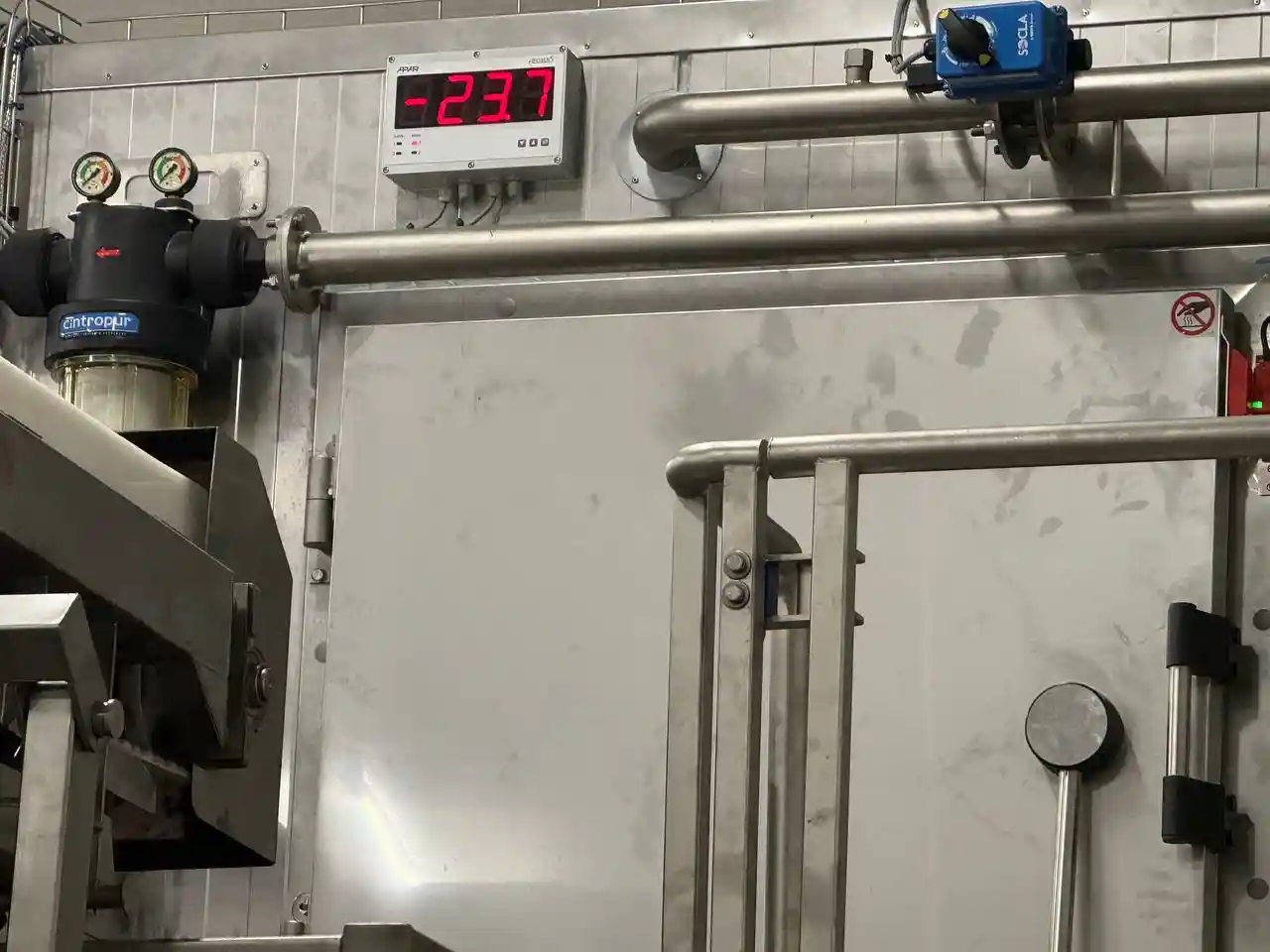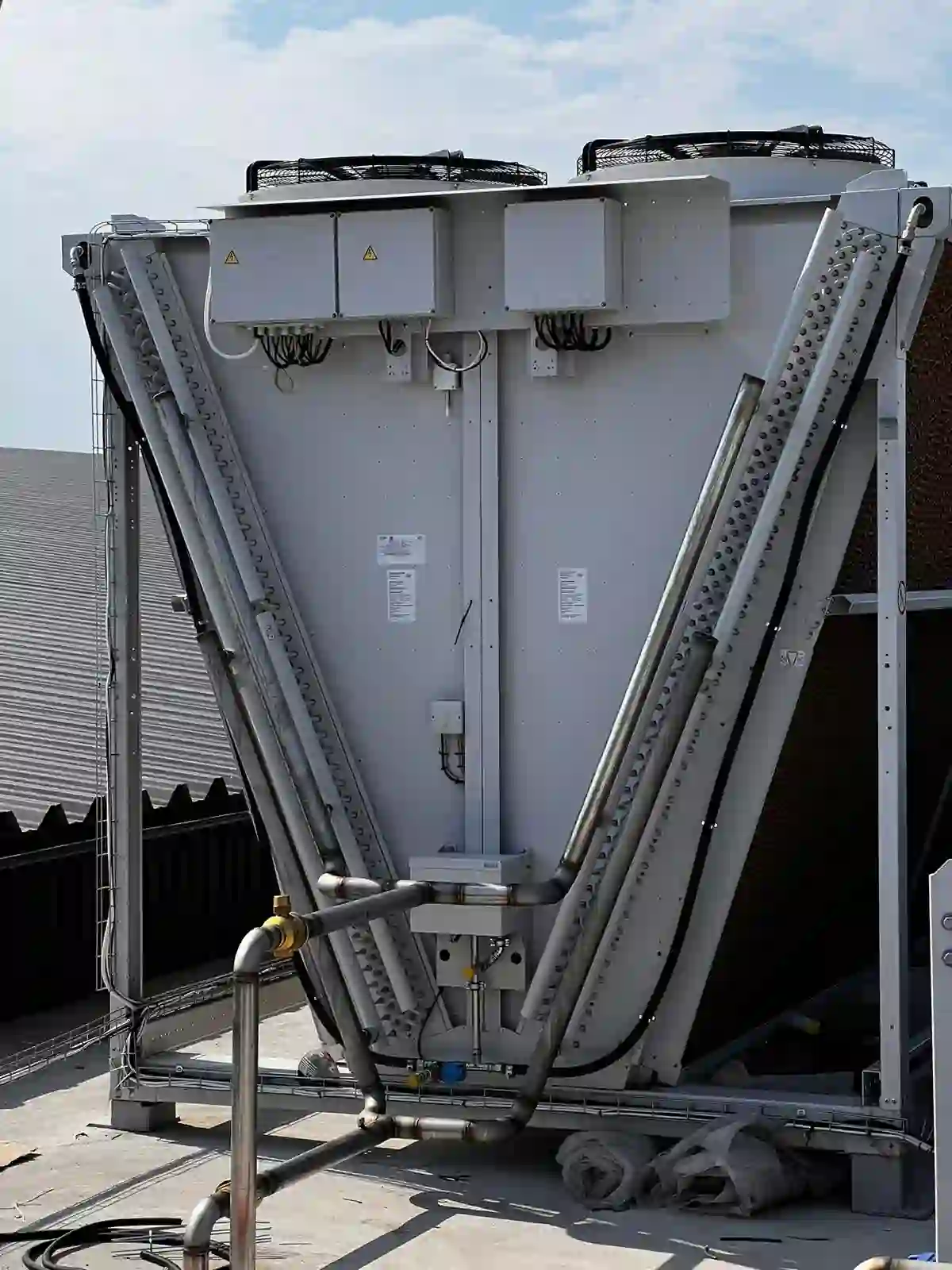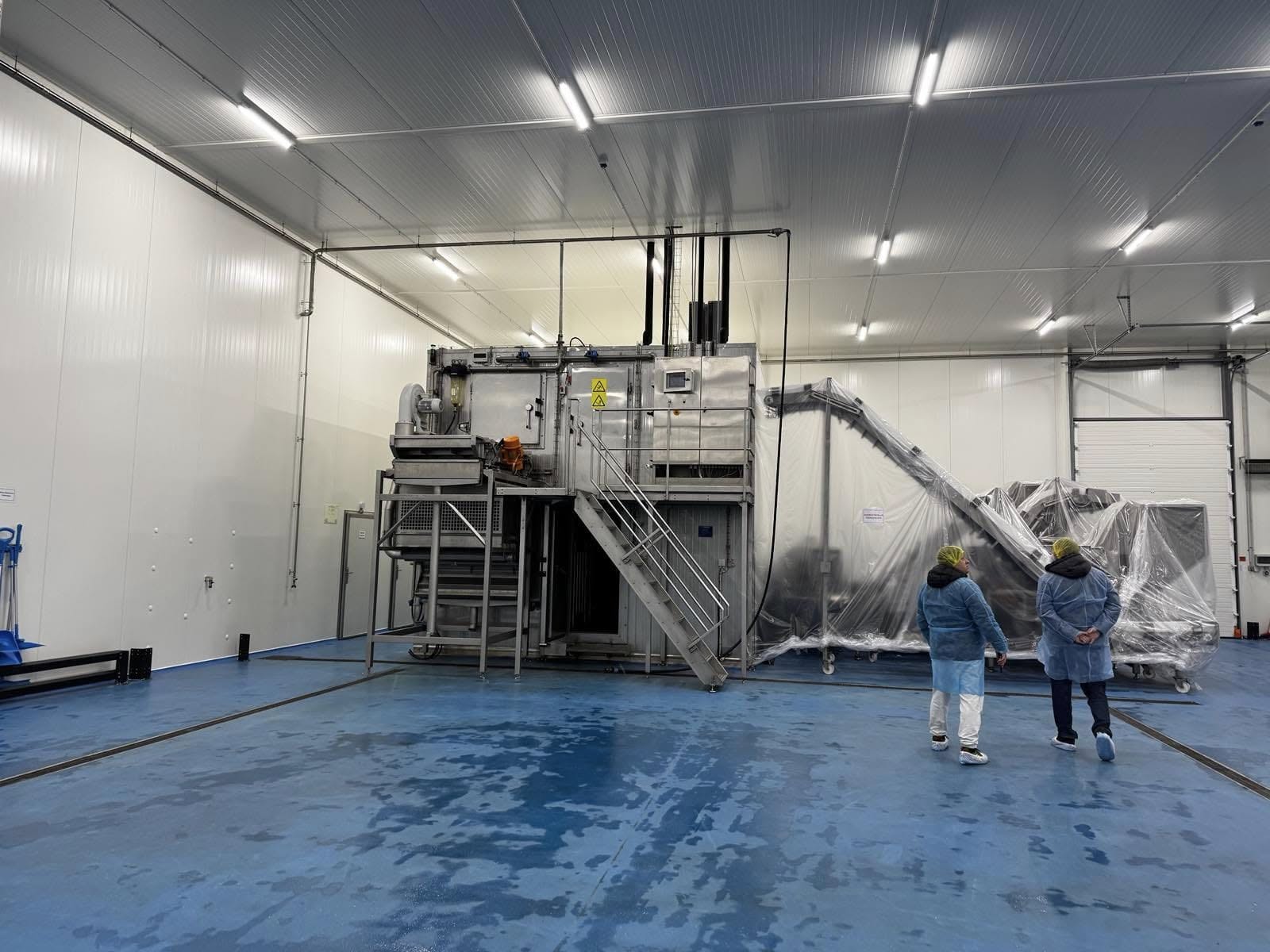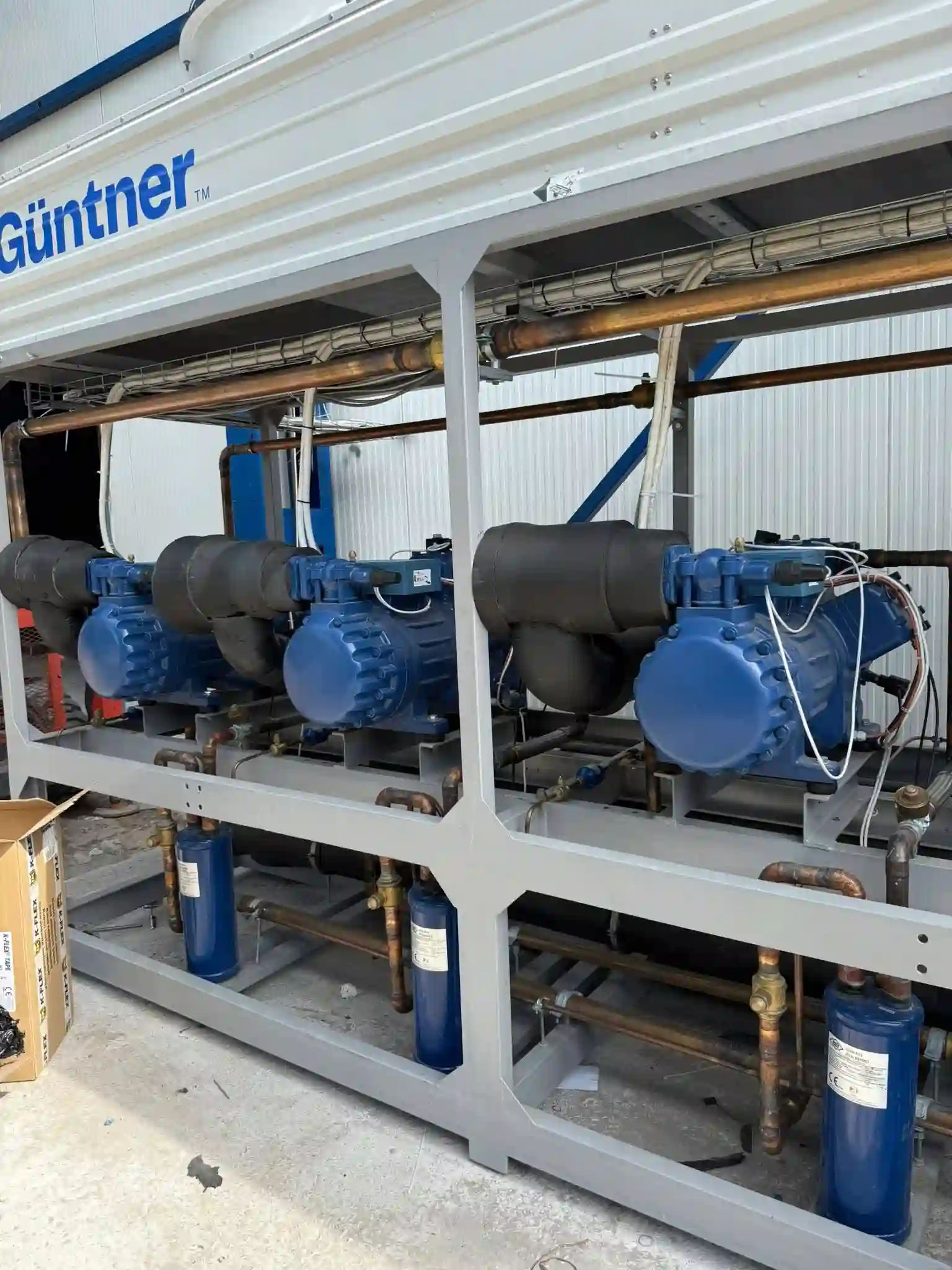
Industrial CO₂ (R744) Refrigeration Systems for Food Processing, Cold Storage, Logistics and Retail
Koriel Group designs, supplies and installs industrial CO₂ (R744) refrigeration systems for food processing, cold storage warehouses, logistics centres and retail. We deliver the full project cycle — from technical audit and cooling load calculation to commissioning and long-term service support.

CO₂ refrigeration systems
CO₂ (R744) — the choice of the future for refrigeration equipment
In a world where environmental responsibility and energy efficiency are becoming key requirements for modern technologies,
the natural refrigerant CO₂ (R744) is emerging as one of the most promising solutions for refrigeration units,
cooling systems, and heat pumps used in industrial and commercial refrigeration.
CO₂ has an extremely low Global Warming Potential (GWP = 1) and zero Ozone Depletion Potential (ODP = 0), making it an
environmentally safe alternative to synthetic refrigerants such as HFCs. In addition to its environmental benefits,
CO₂-based refrigeration systems provide high energy efficiency, stable performance under varying load conditions,
and the ability to recover heat. This allows businesses to significantly reduce operating costs while improving the
sustainability and efficiency of modern cooling and refrigeration technologies.


Why choose CO₂ as a refrigerant?
Advantages of using CO₂ (R744)
Modern industry requires energy-efficient and environmentally responsible solutions in the field of refrigeration technology. CO2 (R744) is not just an alternative to traditional freon refrigerants — it is one of the most promising natural refrigerants used in modern industrial and commercial refrigeration systems, including cooling, freezing, and cold storage applications. As a natural refrigerant with a low global warming potential (GWP), CO2 is increasingly adopted in sustainable refrigeration, energy-efficient cooling systems, food processing facilities, supermarkets, warehouses, and industrial cold chain infrastructure.
-

Eco-Friendly CO2 (R744)
R744 (Natural Refrigerant CO₂)
Sustainable cooling solution with GWP = 1 and ODP = 0. Fully compliant with EU F-Gas Regulation and environmental standards. Ideal for eco-friendly commercial and industrial refrigeration systems. -

Low cost of CO₂ (R744)
R744 is a readily available natural refrigerant that helps reduce overall system operating costs. By choosing CO2, you optimize energy efficiency and ensure long-term compliance, making it a future-proof solution for industrial and commercial cooling.
-

High thermal conductivity
Provides rapid heat transfer and improves the efficiency of refrigeration systems, enabling better cooling performance in industrial and commercial refrigeration equipment.

Transcritical operation
Ensures stable operation of CO2 (R744) refrigeration systems even at high ambient temperatures, maintaining reliable cooling performance and energy efficiency in industrial and commercial refrigeration applications.

Heat recovery
CO2 refrigeration systems enable efficient heat recovery, allowing useful heat generation up to +90°C during system operation for space heating, hot water, and other energy-efficient industrial applications.

Material compatibility
High adaptability and compatibility with modern refrigeration components and materials. We collaborate with leading suppliers of refrigeration equipment and engineering solutions to select the optimal configuration for your specific industrial cooling requirements.
What results can you expect ?
Efficiency of CO₂ refrigeration systems
-

Energy efficiency
Reduction of energy consumption in industrial refrigeration equipment by 30–60%, improving overall performance of energy-efficient cooling systems and cold storage solutions.
-
High COP performance
High coefficient of performance (COP) for refrigeration systems and industrial heat pump applications, ensuring efficient cooling and optimized energy use.
-
Heat recovery
Ability to recover useful heat up to +90°C from refrigeration equipment, supporting industrial heat recovery, hot water production, and energy-efficient facility heating.
-
Environmental sustainability
Compliance with EU environmental regulations for refrigeration systems, using the natural refrigerant CO2 (R744) with ultra-low global warming potential (GWP).
Where is it used?
Applications of CO2 refrigeration systems
CO₂ refrigeration systems are widely used across industrial and commercial sectors where energy-efficient, sustainable, and reliable cooling solutions are required for refrigeration, freezing, product storage, and heat recovery.
-

Supermarkets and shopping centers
Centralized refrigeration systems, display refrigeration cabinets, and freezer units for supermarkets and retail chains using energy-efficient CO₂ refrigeration technology.
-

Food processing industry
Industrial refrigeration equipment for food production, processing, cooling, freezing, and long-term storage in modern food processing facilities.
-

Cold storage and frozen warehouses
Industrial cooling systems for cold storage warehouses, deep-freeze storage facilities, and temperature-controlled storage environments for perishable goods.
-

Heat pumps and heating systems
CO₂ heat pumps for energy-efficient heating, hot water production, and heat recovery from refrigeration systems.

Logistics and distribution centers
Centralized refrigeration solutions for logistics hubs and distribution centers that support reliable temperature control in cold chain logistics.

Medical and pharmaceutical facilities
Specialized refrigeration systems for hospitals, laboratories, and pharmaceutical facilities to safely store vaccines, medicines, and temperature-sensitive medical products.
Who CO2 systems are suitable for
Efficient solutions for businesses with high refrigeration demand
Industrial CO₂ (R744) refrigeration systems are ideal for facilities with medium to high cooling loads where stable temperature control, energy-efficient refrigeration, and compliance with modern environmental standards are essential.
Transcritical CO₂ systems make it possible to integrate refrigeration, air conditioning, and heat recovery into a single engineering solution, reducing operating costs while improving system efficiency and facility management.
These refrigeration technologies deliver the greatest economic benefits for large-scale facilities with centralized infrastructure and continuous refrigeration demand.
Large logistics complexes
- Centralized refrigeration systems for warehouses
- Stable temperature-controlled storage conditions
- Integration with ventilation systems and BMS
- Heat recovery for facility heating
Retail chains and hypermarkets
- Large number of refrigeration circuits
- Continuous refrigeration demand
- Energy-efficient air conditioning systems
- Compliance with F-Gas regulations
Food and agricultural industries
- Strict microclimate requirements
- Precise humidity and temperature control
- Safe natural refrigerant (GWP = 1)
- Integration with automation and control systems
Industrial enterprises
- High heat loads from industrial processes
- Continuous system operation
- Scalable refrigeration infrastructure
- Reduction of operating costs by up to 30%
CO2 project implementation
Implementation stages of industrial CO2 refrigeration systems
We deliver comprehensive solutions for industrial refrigeration systems based on CO₂ (R744) for logistics centers, food processing facilities, and commercial buildings. Our services cover the full project lifecycle — from feasibility studies and system design to automation integration and long-term service support.
-

Technical audit and cooling load calculation
Facility analysis, heat load calculations, identification of medium- and low-temperature refrigeration circuits, and evaluation of the feasibility of implementing a transcritical CO₂ refrigeration system.
-

Engineering design and system modeling
Development of transcritical or booster CO₂ refrigeration system layouts, selection of compressor racks, gas coolers, heat exchangers, and heat recovery solutions for industrial cooling applications.
-

Equipment selection and supply
Supply of compressors, receivers, electronic expansion valves, automation systems, and advanced controllers designed for high-pressure CO₂ refrigeration operation.
-

Installation and system commissioning
Installation of high-pressure refrigeration pipelines, system testing, commissioning in transcritical mode, and optimization of operating parameters.
-

Integration and automation
Configuration of PLC, SCADA, or BMS systems for real-time monitoring of temperature, pressure, and energy consumption, including remote diagnostics and system management.
-

Service and technical support
Preventive maintenance, optimization of system performance, equipment upgrades, and minimization of operational downtime for industrial refrigeration facilities.
Technical comparison
Why facilities are switching from Freon to CO2
Here’s the short version. For the full technical breakdown — including R717 ammonia, detailed pressure specs, and ASHRAE data — see our complete R744 refrigerant guide
For large facilities with continuous cooling demand, CO₂ refrigeration technology often delivers higher efficiency and long-term operational stability.
Parameter CO₂ (R744) Freon systems (HFC) Refrigerant type
Natural, no synthesis required
Synthetic HFC blend
GWP
1 — no carbon exposure
1,400–3,900 — rising carbon costs
ODP
0
0
Working pressure
Higher-spec components required
Standard components
Temperature ranges
Single system covers MT + LT
Often needs separate circuits
COP at high load
Stays strong at scale
Drops with condensing temp
Heat recovery
Usable for hot water & heating
Rarely worth recovering
F-Gas regulation
No restrictions, ever
Being phased down in the EU
Long-term costs
Lower at scale
Refrigerant price risk
Strategic perspective
A long-term solution for the EU and Ukraine
Future regulatory constraints
Conclusion: CO2 for your facility? Get a free technical consultation — our engineers will confirm whether CO2 is the right fit based on your actual load profile and site conditions.
Interested in implementing CO₂ refrigeration technology at your facility?
Request a consultation
FAQ
FAQs about CO₂ refrigeration equipment
-
Yes. We deliver CO2 refrigeration projects for agricultural enterprises, farms, and agro-industrial holdings — including cold storage facilities for vegetables, fruits, berries, and grain, with precise temperature and humidity control and optional controlled-atmosphere storage.
-
In most cases, yes. Our engineers assess the existing plant room, piping, and load profile first, then propose either a full CO2 retrofit or a hybrid solution that reuses compatible equipment — this is usually more cost-effective than a full rebuild.
-
It requires technicians trained specifically for high-pressure CO2 systems, but modern monitoring platforms (Danfoss, Carel) make diagnostics and remote troubleshooting significantly easier than with older HFC plant. We provide maintenance training and ongoing service support as part of every project.
-
Industrial CO2 systems typically run 15–25 years with regular servicing — often longer than comparable HFC installations, since R744 carries no risk of future refrigerant phase-down or supply restrictions.
-
Cost depends on cooling capacity, temperature zones, and whether it’s a new build or retrofit. Because CO2 systems require higher-pressure-rated components, upfront cost typically runs higher than an HFC system — but lower long-term energy and refrigerant costs usually offset this within a few years. We provide a detailed cost estimate after the technical audit.
-
Timelines vary by project scale, but a typical industrial CO2 system takes several weeks for engineering design and 4–12 weeks for installation and commissioning, depending on facility size and complexity. We’ll give you a project-specific timeline after the initial site assessment.
-
Contact our engineers for a free technical consultation. We’ll analyze your facility, calculate cooling load requirements, and prepare a system design and cost estimate tailored to your project.
-
Maintenance requires qualified technicians, but modern monitoring systems, diagnostics, and automation significantly simplify service and troubleshooting.
-
Yes. We implement refrigeration projects for agricultural enterprises, farms, and agro-industrial holdings. We design and build cold storage facilities for vegetables, fruits, berries, grain, and other agricultural products with precise temperature and humidity control. Controlled atmosphere storage systems can also be integrated to extend product shelf life.
-
To select the appropriate CO₂ refrigeration equipment, our engineers first analyze the facility, calculate cooling capacity requirements, and develop a customized refrigeration system design
Completed projects
Our Projects
Clients
We are trusted










Our partners
Work with us










Testimonial
Customers Says

Koriell Group completed the development of a refrigeration machine and its installation on CO2 for berry sublimation. We are very pleased with the cooperation because the work was completed on time. The equipment operates productively and energy-efficiently, which in turn reduces the cost of finished products.

We have had a positive experience working with the Coriel Group team. Just recently, 20-year-old blast freezing system with a new, modern and more efficient system that works flawlessly.
Any Question ?
99.9% Customer Satisfaction Based
+38 (096) 625-80-89If you have any questions or need assistance, please call us or send us an enquiry.
Meet Us
Contact form