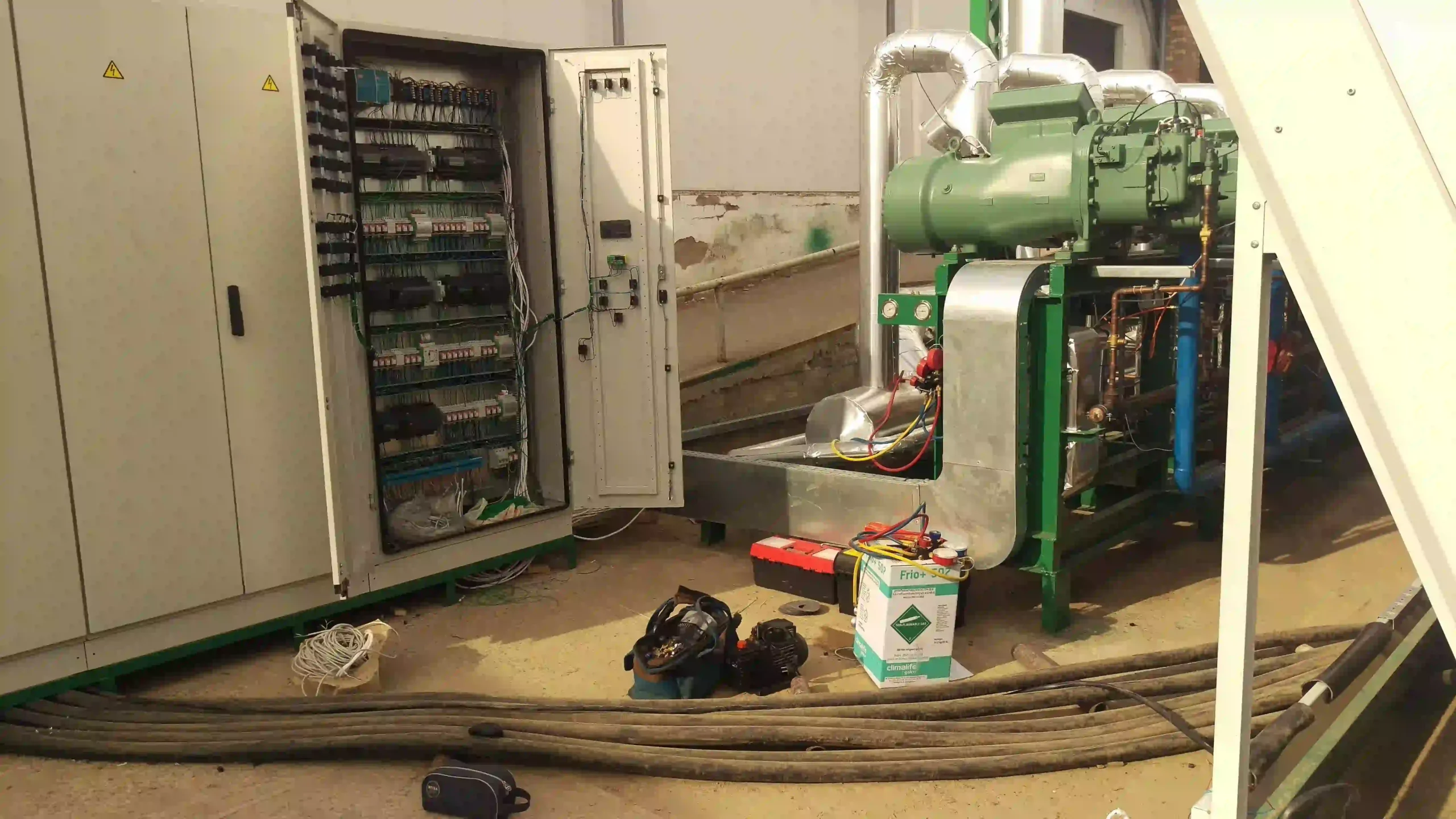
Industrial refrigeration systems are critical infrastructure for food processing facilities, logistics centres, pharmaceutical manufacturers and retail chains. A refrigeration failure lasting just a few hours can mean product losses worth hundreds of thousands in damaged stock, missed deliveries and lasting reputational damage.
Yet the vast majority of emergency refrigeration breakdowns are predictable. They develop gradually and can be identified during planned maintenance long before they become critical. This is why industrial refrigeration system maintenance is not a cost centre — it is a risk management tool.
Over 10 years and 120+ completed projects, the engineering team at Koriel Group has maintained refrigeration systems of all types and capacities across Ukraine and Europe. In this article, we share practical experience: what quality service includes, how to choose the right maintenance partner and what the real cost difference looks like between planned and emergency service.
Why Regular Refrigeration System Maintenance Is Non-Negotiable
Preventing Unplanned Downtime
Most critical failures in industrial refrigeration equipment — compressors, heat exchangers, control systems — have early warning signs: changing operating parameters, increased vibration, unusual noises or a gradual rise in electricity consumption. These can only be detected through regular refrigeration system diagnostics that measure and compare actual performance against design values.
Emergency repair during peak production season always means higher costs, longer lead times for parts and unavoidable production losses. Planned maintenance eliminates the root cause of failure before it occurs.
Reducing Energy Consumption
Refrigeration equipment that is not maintained gradually loses efficiency. Fouled condensers and evaporators reduce heat transfer — the compressor is forced to work harder and run longer cycles to reach the set temperature. The result: the same cooling output costs 15–25% more in electricity.
Regular heat exchanger cleaning, refrigerant charge verification and compressor parameter monitoring restore the system to its design efficiency — and directly reduce energy bills.
Extending Equipment Service Life
Industrial refrigeration systems represent a significant capital investment. With proper maintenance, quality equipment can operate reliably for 15–25 years. Without it, this figure can halve: a compressor rated for 80,000 hours may fail after 30,000–40,000 hours when consistently operating under abnormal conditions.
Regulatory Compliance
Food processing, pharmaceutical and logistics facilities are required to document compliance with temperature regimes. Regular cold room maintenance with a maintained service log is a prerequisite for HACCP, GMP and other industry audit standards. A service contract with documented visit reports provides this evidence automatically.
What Industrial Refrigeration Maintenance Includes
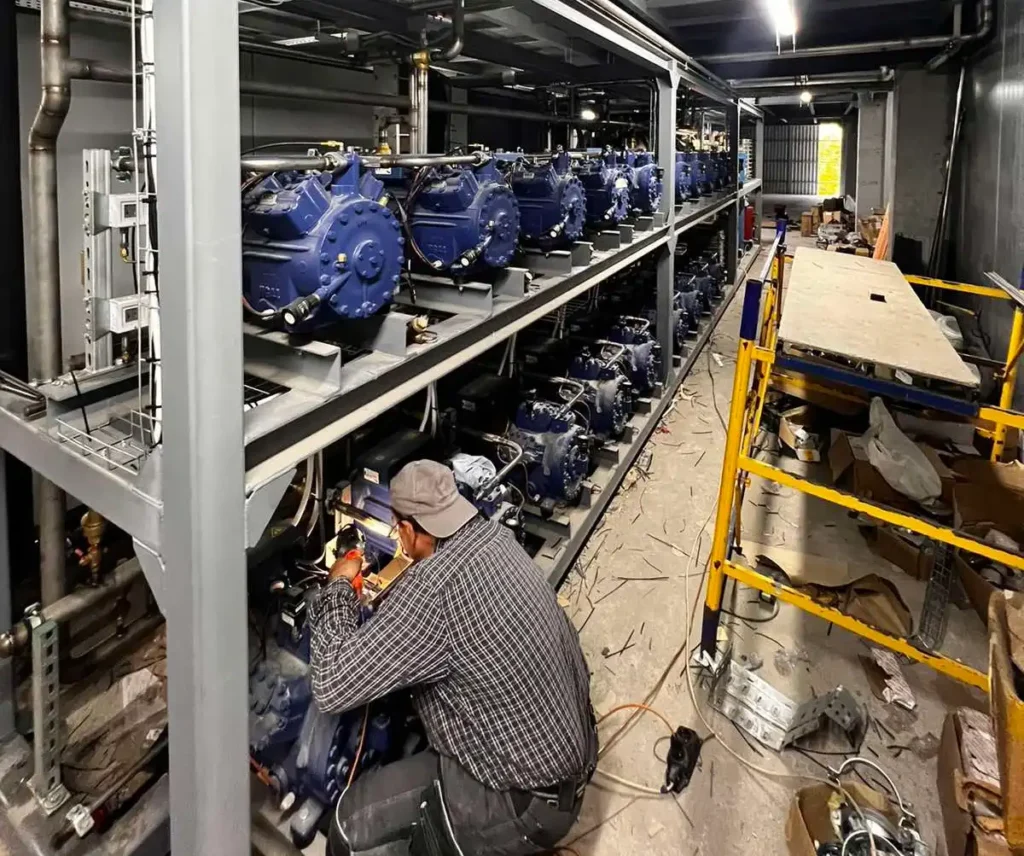
Quality planned preventive maintenance for industrial refrigeration systems is a comprehensive programme, not a single-parameter check. Here is what Koriel Group’s service engineers carry out at each planned visit:
1. System Diagnostics and Refrigerant Circuit Leak Check
Refrigerant leaks are one of the most common hidden causes of reduced system performance. In early stages they are invisible without specialist equipment, but gradually lead to reduced cooling capacity, compressor overload and, ultimately, compressor failure.
At each maintenance visit, a leak detection check is performed across the full circuit, suction and discharge pressures are measured, and superheat and subcooling values are verified against the design parameters of the specific system.
2. Condenser and Evaporator Cleaning
Air-cooled condensers in industrial environments accumulate dust, grease and process contamination. At just 20–30% fouling, condensing pressure rises and system efficiency drops noticeably. Cleaning is performed mechanically or chemically depending on the type and level of contamination.
3. Compressor and Oil Condition Check
The compressor is the most critical and most expensive component of any refrigeration system. Maintenance includes oil level and condition inspection (where an oil circuit is present), discharge temperature measurement and current draw comparison against nominal values. Deviations flag developing problems well before failure occurs.
4. Control System and Automation Check
Modern industrial refrigeration systems are managed by controllers that handle temperature setpoints, defrost cycles and safety interlocks. Sensor calibration, algorithm verification and fault log review are essential elements of every maintenance visit.
5. Door Seal and Insulation Inspection
Damaged cold room door seals create a continuous pathway for warm, humid air into the chamber — resulting in heavy ice formation on the evaporator, more frequent defrost cycles and increased compressor load. Seal inspection takes minutes but has a measurable impact on energy consumption.
6. Electrical Connection and Safety Device Check
Loose terminals, oxidised connections and faulty protective relays are a common cause of unstable operation and unexpected shutdowns. Each visit includes inspection of starter and protection equipment, earthing continuity and cable connection condition.
7. Performance Assessment and Written Report
After every planned maintenance visit, Koriel Group provides a written report with recorded system parameters, work completed and recommendations. This is both internal documentation and, where required, evidence of appropriate maintenance for regulatory audits.
Emergency Refrigeration Repair: When Prevention Was Not Enough
Even with regular maintenance, emergency situations can arise — due to external factors, power supply issues or the sudden failure of a component that has reached the end of its service life. In these situations, the speed of the service team’s response is critical.
For emergency cold room and refrigeration system repair, Koriel Group follows a priority protocol:
- call intake and initial telephone diagnostics — enabling the engineer to prepare the most likely required parts before departure;
- engineer dispatch — prioritised for clients on a service contract;
- on-site fault localisation and scope of work assessment;
- repair or temporary system restoration with planned root cause resolution to follow;
- post-repair system verification and completion report.
Clients without a service contract in an emergency situation receive the same technical standard of support, but response timing depends on current workload and location.
Planned vs Emergency Service: A Cost Comparison
| Parameter | Planned Maintenance | Emergency Repair |
|---|---|---|
| Call-out cost | Fixed (contract rate) | Premium emergency rate |
| Response time | Scheduled, at a convenient time | Subject to availability |
| Parts cost | Contract discount pricing | Market rate + urgency premium |
| Production losses | None | Hours to days |
| Product loss risk | Minimal | High |
| Cost predictability | Full | Unpredictable |
Based on Koriel Group project experience, facilities that transition from reactive to planned preventive maintenance reduce total refrigeration infrastructure support costs by 30–50% over two to three years.
Signs Your Refrigeration System Needs Immediate Diagnostics
Do not wait for the next scheduled visit if you observe any of the following:
- Chamber temperature above setpoint — the system is not meeting load or there is a refrigerant leak;
- Compressor running continuously without stopping — sign of overload or low refrigerant charge;
- Increasing electricity consumption without load change — heat exchanger fouling or system degradation;
- Unusual noise or vibration — sign of wear in compressor mechanical components or fans;
- Excessive ice build-up on the evaporator — defrost cycle failure or increased warm air infiltration;
- Frequent alarm activations — system operating outside normal parameter range;
- Visible oil traces on pipework or equipment — probable refrigerant or oil leak.
Any of these symptoms warrants an unscheduled engineer call-out — not waiting until the next planned visit.
How to Choose the Right Refrigeration Service Partner
The market offers a wide range of companies providing industrial refrigeration maintenance and repair services. When selecting a partner, several factors are worth evaluating carefully:
- Proven experience with industrial equipment specifically. Servicing domestic refrigerators and industrial compressor packages are fundamentally different competencies. Confirm that the company has demonstrated experience with equipment of your type and capacity.
- Own spare parts stock. In an emergency, parts lead time is a critical variable. A partner with an in-house stock of common components resolves most failures in a single visit.
- Engineer qualifications. Working with refrigerants and industrial refrigeration equipment requires appropriate certifications and training. Ask to see documentation.
- Transparent reporting. After every maintenance visit you should receive a written report with actual system operating parameters — not just a signature in a logbook.
- Clear service contract terms. Defined SLAs (response times), fixed planned visit pricing and a clear emergency call-out procedure are the hallmarks of a professional service organisation.
Refrigeration Service from Koriel Group
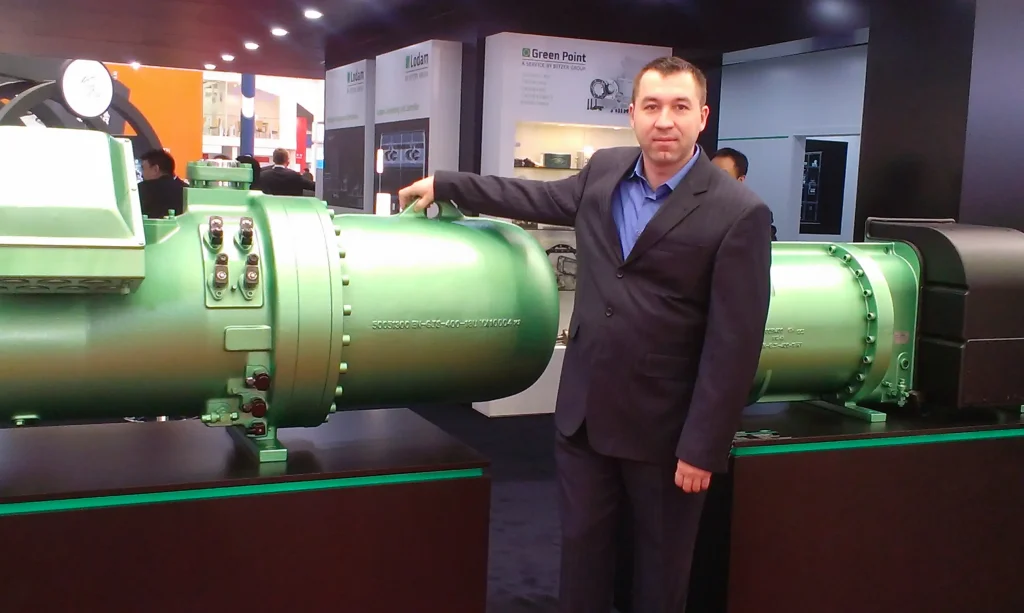
Koriel Group provides maintenance and repair services> for industrial refrigeration systems across Ukraine and for European projects. We service equipment from multiple manufacturers and in all configurations — from compact packaged units to large-scale refrigeration complexes with multiple compressor stations.
What clients on a Koriel Group service contract receive:
- planned maintenance visits at an agreed frequency and fixed cost;
- priority response for emergency situations;
- discounts on spare parts and consumables;
- written reports after every visit with system performance trend data;
- recommendations for operating mode optimisation and energy cost reduction;
- engineer consultation on any equipment-related questions.
For facilities with multiple sites or complex refrigeration infrastructure, Koriel Group develops individual service programmes that account for production specifics and site geography.
Conclusion
Regular industrial refrigeration system maintenance is not an overhead — it is the most cost-effective way to manage the risks associated with refrigeration infrastructure. Planned diagnostics identify problems before they develop into failures, reduce electricity consumption and extend the service life of expensive equipment.
Emergency repair always costs more — not only in direct costs, but in production losses, damaged product and reputational risk. Facilities that move to systematic planned preventive maintenance typically save 30–50% of total refrigeration infrastructure support costs over two to three years.
Contact us to receive a tailored maintenance plan and cost proposal for your facility.