
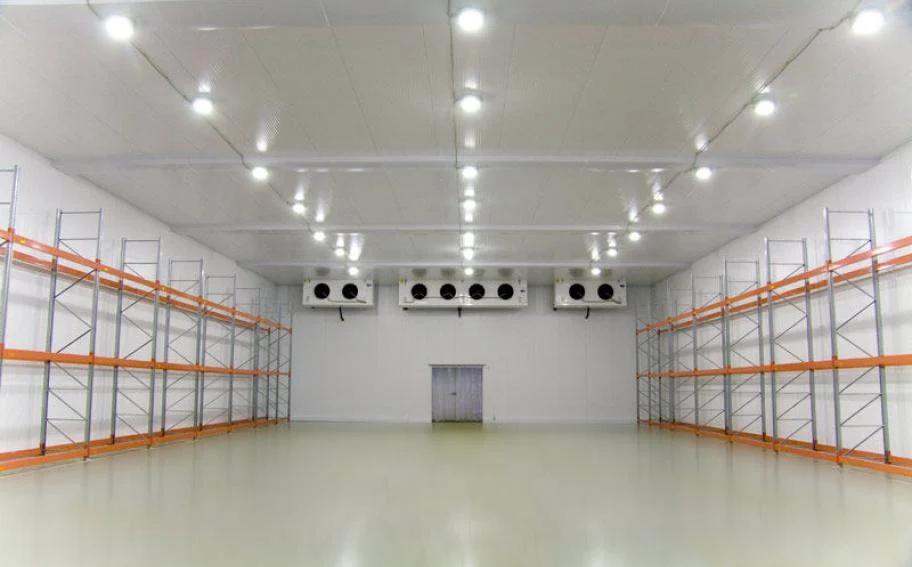
When food manufacturers plan a blast freezing chamber — whether for meat, fish, berries, vegetables or ready meals — the first question is almost always about compressor capacity. The right question, however, is different: how well is the chamber insulated?
After 10 years and 120+ completed industrial refrigeration projects across Ukraine and Europe, Koriel Group’s engineering team consistently reaches the same conclusion: properly designed and installed cold room insulation for blast freezing chambers reduces actual electricity consumption by 15–30%, extends compressor service life and guarantees consistent product quality throughout the freezing cycle.
Why Cold Room Insulation Is an Engineering Decision, Not a Construction Detail
A common misconception in the food industry: insulation is the builder’s responsibility, refrigeration is the contractor’s. In reality, they form a single thermodynamic system — and must be engineered together.
The total thermal load of a blast freezing chamber consists of several components: heat from the product, staff, door openings, lighting — and, critically, heat gain through the walls, ceiling and floor. With poor insulation, this last component alone can account for 25–40% of the total thermal load.
In practice, this means the compressor spends up to 40% of its capacity compensating for heat leakage through the building envelope — rather than actually freezing the product.
The Physics of Energy Savings: Where the 15–30% Comes From
Heat flow through a cold room wall is governed by a straightforward principle: it increases with the temperature differential and decreases with the thermal resistance of the structure. For a blast freezing chamber at −35°C with an external temperature of +20°C, that differential is 55°C — an extremely demanding condition for any insulation system.
Modern PUR (polyurethane) sandwich panels have a thermal conductivity of λ ≈ 0.022–0.025 W/(m·K) — among the lowest of any commercially available insulation material. At a panel thickness of 200 mm, this delivers a U-value of approximately 0.11–0.125 W/(m²·K), which aligns with international energy efficiency standards for industrial blast freezers.
Where older or thinner panels (100 mm) are in use, or where materials with higher thermal conductivity have been installed, heat gains through the building envelope can be two to three times higher. Upgrading to correctly specified insulation directly eliminates this excess thermal load — and that is where the 15–30% energy saving is generated.
Six Key Factors That Determine Blast Freezer Insulation Performance
1. Insulation Material and Panel Thickness
PUR sandwich panels with factory-fitted cam-lock joints are the industry standard for blast freezing chambers. Recommended minimum thickness for a −35°C operating temperature:
- Walls — 150–200 mm
- Ceiling — minimum 200 mm
- Floor — minimum 200 mm
Mineral wool is not suitable for blast freezers: it is vapour-permeable, absorbs moisture under the temperature cycling typical of freezing chambers and can lose up to 60% of its thermal performance within one to two operating seasons.
2. Thermal Bridges
Metal fixings, corner connections and structural elements that link the inner and outer skins of a panel are the most common — and most underestimated — source of heat gain. Even otherwise excellent panels will underperform if thermal bridges are not eliminated at design stage.
Correct engineering specifies thermal break inserts at all fixing points and minimises metal elements in zones of high temperature differential. This is a design decision, not a site decision.
3. Door Seals and Joint Integrity
A poorly sealed cold room door is the fastest route for warm, humid air to enter the chamber. The consequences are immediate: ice build-up on the evaporator, more frequent and longer defrost cycles, additional compressor starts and accelerated wear.
Required measures include:
- Automatic door closers with position monitoring
- Double magnetic seals with verified contact pressure
- Quarterly inspection and replacement of door gaskets
- Full sealant application at all panel joints and corners
4. Floor Insulation
The floor is the most consistently neglected element of cold room insulation — yet in chambers installed on concrete slabs, ground or heated floors, floor heat gain can exceed wall heat gain. Koriel Group’s site audits regularly find that 30–40% of existing blast freezer installations have no floor insulation, or insulation that is inadequate for the operating temperature.
A correctly specified floor build-up for a blast freezing chamber:
- PUR insulation ≥ 200 mm thickness
- Waterproof membrane (EPDM or equivalent)
- Reinforced concrete screed
- Staggered joints between layers to eliminate thermal bridging
5. Airflow Design and Evaporator Positioning
Thermal insulation and internal airflow design are inseparable. If the cold air stream does not reach certain zones within the chamber, warmer microclimates develop and the compressor works harder to compensate. Evaporator location, air duct geometry and airflow velocity must be determined at design stage — not retrofitted after commissioning.
6. Insulation Ageing and Planned Maintenance
PUR can degrade under mechanical damage or moisture ingress. Without planned inspection, insulation deterioration goes undetected — and becomes visible only when energy bills have already risen significantly.
Recommended inspection schedule:
- Door gaskets — quarterly
- Panel joints and floor condition — annually
- Thermographic survey (where monitoring systems are installed) — continuous
Common Mistakes That Undermine Cold Room Insulation
Even premium-specification panels will deliver poor results if the following errors are made during design or installation:
- Ignoring the floor as a heat source — the most common and most costly single mistake in cold room construction
- Using materials not rated for freezing environments — mineral wool without a continuous vapour barrier is not acceptable in a blast freezer
- Omitting sealant at corners and around door frames — creates a permanent pathway for warm air infiltration
- Metal fixings without thermal breaks penetrating through the full panel depth — each one is a direct thermal bridge
- No planned maintenance programme — insulation deterioration is invisible until it has already become expensive
- Incorrect installation sequence — panel joints without factory locks or foam-filled gaps introduce performance inconsistency
Insulation and CO₂ Refrigeration Systems: A Multiplied Benefit
Koriel Group specialises in CO₂ (R744) industrial refrigeration systems — a natural refrigerant with zero ozone depletion potential and a GWP of 1, fully compliant with EU F-Gas regulations and the ongoing European phase-down of high-GWP refrigerants.
CO₂ systems are particularly demanding of insulation quality — and particularly responsive to its improvement:
- Reduced heat gain means fewer compressor start cycles — by a factor of two to three
- System COP improves disproportionately as thermal load falls — a non-linear efficiency gain
- Compressor service life extends by 30–40% with fewer operating hours at peak load
- The risk of unplanned shutdowns due to high-pressure events is significantly reduced
Further savings are available through heat recovery from the CO₂ condenser — in 24/7 food processing facilities this can deliver free heat for domestic hot water or space heating, recovering a meaningful share of total electrical input.
Return on Investment: Real Figures for Decision-Making
The table below shows indicative payback periods for insulation investment across different facility types, based on actual Koriel Group project data:
| Facility Type | Operating Hours | Energy Saving | Payback Period |
|---|---|---|---|
| Blast freezer — berries / vegetables | 18–24 h/day, 6-month season | 15–22% | 1.5–2.5 years |
| Continuous blast freezing line — meat / fish | 24/7, year-round | 20–30% | 1–1.8 years |
| Cold storage warehouse | 12–18 h/day, year-round | 10–18% | 2–3.5 years |
| Freeze-drying facility | 24/7, year-round | 18–25% | 1.2–2 years |
Total lifecycle cost matters more than upfront panel price. Lower-cost panels typically degrade faster, require remedial work and cause unplanned production stoppages. Quality materials and correct installation deliver stable performance — and stable energy bills — for 15 years or more.
Practical Recommendations from Koriel Group Engineers
Based on the engineering experience from 120+ industrial refrigeration projects across Europe, our team has identified six recommendations that directly and measurably affect blast freezer energy performance:
- Start with a thermal load calculation, not a compressor selection. Define the full heat balance of the chamber first — product load, infiltration, envelope losses — then select the refrigeration system to match. This prevents both undersizing and unnecessary over-specification.
- Require a certified data sheet with a confirmed λ-value for every panel. For blast freezing chambers the requirement is λ ≤ 0.025 W/(m·K). Without a verified data sheet, you are accepting an unknown energy cost for the next 10–15 years.
- Specify floor insulation as part of the base design, not as an option. Retrofitting floor insulation into an operating facility costs three to five times more than including it in the original build.
- Install an energy and temperature monitoring system. Automated monitoring platforms detect rising heat gains — the early sign of insulation deterioration — before they appear on the electricity bill.
- Include insulation inspection in the refrigeration maintenance contract. Koriel Group service clients receive planned inspections of panel joints, floor condition and door gaskets as part of their scheduled maintenance visits.
- Consider heat recovery as part of the overall energy balance. The heat extracted from the product during blast freezing has to go somewhere. In a well-designed CO₂ system, that heat can be put to productive use — reducing the facility’s net energy cost and improving its overall sustainability profile.
Blast Freezer Insulation and EU Energy Regulations
For food industry operators in Poland, Germany and across the European Union, the energy performance of cold rooms is increasingly subject to regulatory attention. The EU’s Energy Efficiency Directive and the ongoing revision of F-Gas regulations are driving both mandatory minimum standards and strong incentives for early adoption of best-practice insulation and natural refrigerant systems.
CO₂ refrigeration systems with correctly specified insulation represent the most future-proof combination available today: compliant with current EU environmental regulations, eligible for energy efficiency support programmes in multiple member states and structured to remain competitive as energy prices continue to rise across European markets.
Conclusion
Cold room insulation for blast freezers is not a secondary consideration — it is the thermal foundation on which the entire refrigeration system’s performance rests. Correctly specified and installed insulation reduces electricity consumption by 15–30%, reduces compressor wear and maintains consistent product quality throughout the freezing cycle.
A comprehensive approach — quality PUR panels, eliminated thermal bridges, airtight door seals, insulated floor and a monitoring system — delivers payback within 1–2 years in continuous-operation facilities and generates stable savings for the full service life of the installation.
Koriel Group provides design, installation and long-term maintenance of blast freezing systems, cold storage facilities and complete CO₂ industrial refrigeration solutions for food industry clients across Ukraine, Poland, Germany and the wider European market.
Contact us for a free thermal load assessment of your facility and a tailored engineering proposal.